Choosing a commercial space in Round Rock is not just about finding a good building. It is about finding the right corridor for how your business actually works. If you are opening, expanding, or relocating, you need to think about traffic patterns, visibility, access, zoning, and how city projects could affect your customers and operations over time. This guide will walk you through Round Rock’s main commercial corridors, what types of businesses tend to fit each one, and what to review before you sign a lease or contract. Let’s dive in.
Why corridor choice matters in Round Rock
Round Rock has the customer base and economic activity to support a wide range of small businesses. The U.S. Census Bureau estimates the city’s 2024 population at 135,359, with 48,647 households, a median household income of $99,287, and 2,986 employer firms. The city also reported $5.578 billion in retail sales in 2022, plus $807.7 million in accommodation and food sales.
That scale matters, but so does the street network. According to the city’s Transportation Master Plan, Round Rock is continuing to invest in major roadway improvements, with nearly $2 billion in identified transportation projects over the next 20 to 30 years. In practical terms, that means your location decision should account for both current access and future corridor changes.
Downtown Round Rock
Best for walkable, destination businesses
Downtown Round Rock, centered around Main Street, Mays Street, and Round Rock Avenue, is the city’s historic commercial core. The city notes that downtown sits less than half a mile from IH-35 and includes a National Register historic district, while its downtown planning and zoning updates are aimed at supporting more density and a stronger mix of retail, dining, entertainment, residential, and public-space uses.
If your business benefits from walkability and a sense of place, downtown is often the strongest fit. This includes destination retail, restaurants, personal services, and small professional offices. It is less about highway-speed convenience and more about visibility within a compact, active district.
What to watch downtown
Downtown also comes with more rules than some other parts of the city. The historic district overview and downtown zoning standards make it clear that design, signage, sidewalk use, and certain exterior changes may be subject to additional review.
That does not make downtown harder by default, but it does mean you should study the details early. If your concept depends on signage, patio seating, food truck components, or exterior upgrades, those items need to be part of your site selection review from day one.
University Boulevard corridor
Best for education, medical, and service uses
University Boulevard is one of Round Rock’s most practical corridors for small businesses that serve students, staff, nearby households, and daytime visitors. The corridor connects major demand drivers including Austin Community College’s Round Rock Campus and Texas State University’s Round Rock Campus, while the city has also completed major widening and reconstruction work along key segments.
This area often makes sense for medical office, small office, tutoring, wellness, food concepts, and service retail. The mix of institutional uses and neighborhood-serving demand can create steady activity throughout the day.
What matters most here
Along University Boulevard, access can matter just as much as address. A site with acceptable rent but poor turning access, awkward parking, or difficult frontage-road circulation may be less effective than a slightly more expensive option with easier entry and exit.
This is a corridor where you want to evaluate daily function in real terms. Think about customer parking, employee parking, delivery patterns, and whether your customers are willing to make multiple turns just to reach your storefront.
I-35, SH 45, Greenlawn, and La Frontera
Best for visibility and regional draw
If your business depends on strong vehicle traffic, regional access, and easy recognition, the I-35 and SH 45 area deserves close attention. A city existing-conditions report identifies I-35 as Round Rock’s major commercial corridor and describes La Frontera as a mixed-use area with retail, restaurants, hospitality, and multifamily uses.
This broader node remains one of the city’s most visible commercial zones. It can be a strong fit for restaurants, larger service retail users, medical and office tenants, and businesses that want convenient access from multiple parts of the region.
Why this area is still evolving
This district is not standing still. The city announced that The District at SH 45 and Greenlawn Boulevard is underway as a major mixed-use project, with at least 600,000 square feet planned for commercial and retail uses, alongside office, multifamily, and green space.
At the same time, Greenlawn Boulevard is being widened from IH-35 to SH 45. For a small business, that is both an opportunity and a reminder. Strong infrastructure investment can support long-term growth, but it also means you should understand how construction timing and changing traffic flow could affect your launch or operations.
US 79, Red Bud, and Old Settlers
Best for growth-oriented and larger-format users
The east and northeast side of Round Rock feels different from downtown and the I-35 corridor. It functions more as a growth area, with city-backed road projects designed to improve long-term capacity and east-west connectivity. According to the city, the North Red Bud Lane project and the Old Settlers Boulevard Extension are intended to support that future growth and help relieve traffic pressure on Highway 79.
For small businesses, this area may be a better fit for service retail, contractor-oriented businesses, medical support users, flex space, and industrial or larger-site users. It is usually less about a charming storefront environment and more about function, land efficiency, and future accessibility.
The biggest issue here: future access
A lower-cost site can be attractive, but you need to look beyond today’s map. If nearby road widening, connector extensions, or utility work are planned, traffic patterns could shift after you move in.
That is why this corridor requires a forward-looking review. A site that feels early today may become much stronger over time, but only if the property’s access, use permissions, and improvement needs line up with your business model.
Business parks and flex nodes
Best for office-warehouse hybrids
Round Rock is not only a retail market. The city’s roadway impact-fee study specifically defines business parks and flex-type buildings, along with small office, office park, medical-dental office, and related formats. That is a useful reminder that local inventory includes more than storefronts and restaurant pads.
For many businesses, flex space is the right answer. Contractor offices, storage-heavy users, e-commerce support operations, lab-support users, and businesses that need both office and warehouse functions often perform better in business park environments than in retail centers.
What to evaluate in flex space
In these properties, loading and building function usually matter more than pedestrian frontage. You should pay close attention to truck movement, parking, utility capacity, clear height, and how expensive it would be to adapt the space for your actual use.
City announcements tied to projects like Chisholm Trail Trade Center, Crystal Park, Altman Business Park, Settlers Grove, and EastGroup industrial activity show that this type of product remains part of Round Rock’s commercial landscape. If your business runs on operations more than walk-in traffic, these nodes may deserve a serious look.
Common property types in Round Rock
Before you start touring spaces, it helps to understand the basic formats you are likely to encounter.
Retail pads and outparcels
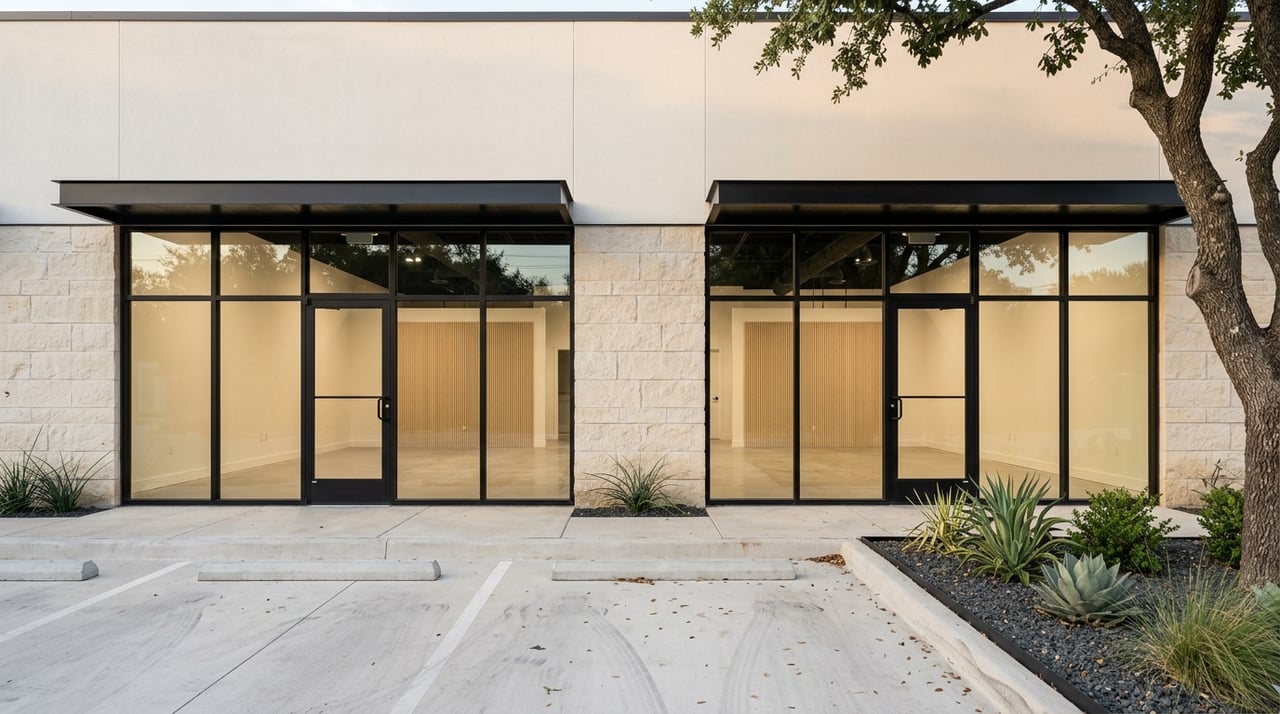
Retail pads are best suited for businesses that need frontage, visibility, and quick in-and-out access. In Round Rock, planned development documents have allowed pad sites for eating establishments, retail sales, and service uses, which aligns with the city’s auto-oriented commercial pattern.
Small office and medical office
The city treats small office as a distinct building type of 10,000 square feet or less, and also recognizes medical-dental office and office-park formats. That makes Round Rock flexible for solo professionals, service providers, and medical users in several corridors.
Flex and business park space
Flex space works well for users who need a mix of office and warehouse functionality. It is often the best match for practical, operations-driven businesses that need parking, loading, and storage more than display windows.
Mixed-use space
Mixed-use space is most visible downtown and in large planned projects like The District. These environments may work well if your business benefits from shared parking, adjacent activity, and a broader live-work-play setting.
What to review before signing
Check zoning and district rules
The city’s business location guidance makes this clear: not every business is allowed in every part of Round Rock. This is especially important if a property is in a planned unit development, downtown mixed-use district, or the historic core.
Confirm permits and occupancy needs
Round Rock does not require a general business license, but it does require a DBA filing at the county level and may require permits depending on the business type. If you are altering space, changing systems, or changing occupancy, the city’s building-inspection process may also come into play.
Study parking and traffic flow
The city specifically warns that a space that works for one use may not work for another because of parking. A retail storefront may not have enough parking for a restaurant, and a corner site may look visible on paper but still be awkward for customers to enter.
Review accessibility and buildout scope
Before you commit, identify whether the space may need electrical upgrades, ventilation, sprinklers, disability-access improvements, or other tenant improvements. Buildout costs can quickly change the economics of an otherwise appealing lease rate or purchase price.
Bring in local guidance early
The SBA’s business location guidance notes that location affects zoning, taxes, regulations, and lease terms. In Round Rock, that is a strong case for getting local commercial guidance before you lock in a site, especially if the property sits in an evolving corridor or a specialized zoning district.
How to match your business to the right corridor
A simple way to narrow your options is to start with how your customers reach you and how your space needs to function.
- If you want walkability and destination appeal, start with downtown.
- If you serve students, staff, medical users, or daytime service traffic, look closely at University Boulevard.
- If your business needs regional visibility and high vehicle counts, focus on I-35, SH 45, Greenlawn, and La Frontera.
- If you need larger sites, operational flexibility, or long-term growth potential, explore US 79, Red Bud, Old Settlers, and business park areas.
The best Round Rock location is usually not the cheapest space or the newest building. It is the one where your use is permitted, your customers can reach you easily, your buildout makes financial sense, and future corridor changes support your business instead of disrupting it.
If you are weighing locations in Round Rock and want a clear, data-informed second opinion, Dueñas Realty Group can help you compare corridors, evaluate fit, and move forward with more confidence.
FAQs
What commercial corridor in Round Rock is best for a restaurant?
- Downtown and the I-35, SH 45, and La Frontera area are often strong options, but the right fit depends on parking, visibility, access, and whether the zoning allows your use.
What makes University Boulevard a strong location for small businesses in Round Rock?
- University Boulevard connects higher-education campuses, medical and service demand, and improved roadway access, which can support office, wellness, tutoring, food, and service businesses.
What should a small business check before leasing space in downtown Round Rock?
- You should review zoning, signage rules, historic-district considerations, parking, buildout needs, and whether your business model fits a more pedestrian-oriented district.
Why are Red Bud Lane and Old Settlers Boulevard important for future commercial growth in Round Rock?
- City road projects in that area are improving long-term access and connectivity, which may support service retail, flex, industrial, and larger-format commercial uses over time.
Does Round Rock require a general business license for small businesses?
- No, the city says it does not require a general business license, but your business may still need a DBA filing and other permits depending on the use and the property.
When should a business owner involve a commercial real estate advisor in Round Rock?
- It is smart to involve an advisor early, especially if you are comparing corridors, evaluating buildout costs, reviewing lease terms, or considering a site in a PUD, mixed-use area, or active construction zone.